
The Birth of a Round Nail: The Transformation from Steel Wire to Industrial Fastener
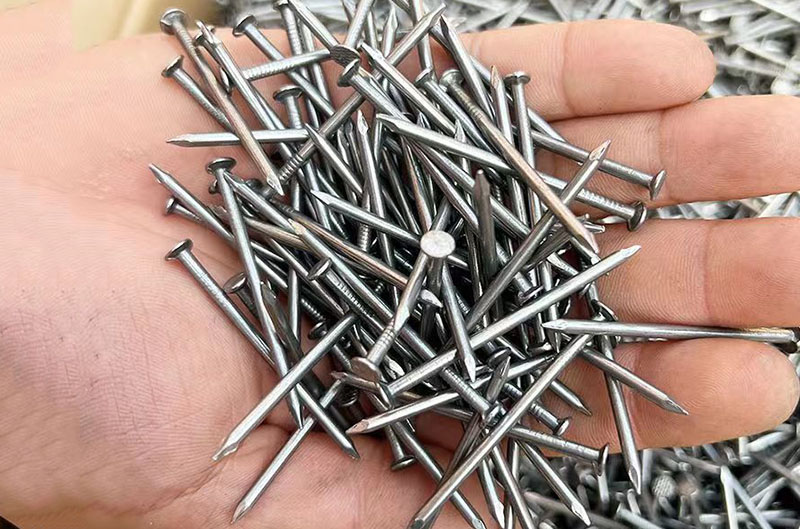
On the scaffolding of construction sites, in the assembly workshops of furniture factories, and even in the toolboxes of ordinary households, round nails are the most unassuming yet indispensable items. This seemingly simple small metal object has to go through nearly ten precise processes to transform from a dark steel wire into an industrial fastener with both strength and toughness. Today, we will uncover the mystery of round nail production and see how a qualified round nail is "forged".
1. Material Selection: Laying a Solid Foundation for Round Nails
The quality of round nails is determined from the moment the raw materials are selected. Factories usually choose low-carbon steel wires (such as Q195, Q215) or medium-carbon steel wires (Q235) as the core raw materials. Low-carbon steel has good toughness and is not easy to break, while medium-carbon steel has high strength and can meet more demanding fixing requirements. For high-end products used in outdoor and humid environments, 304 or 316 stainless steel wires are adopted to improve rust resistance from the source.
After the raw materials are stored in the warehouse, the first pre-treatment process is "cleaning and straightening". Workers carefully check the diameter of the wire (usually 1.6-6.0mm) to remove the oxide scale, oil stains and impurities on the surface. Then, professional equipment is used to straighten the bent wire to ensure uniform stress during subsequent processing and avoid dimensional deviations.
2. Wire Drawing: Making the Wire "Slim Down" and Refine
The rough wire after pre-treatment first undergoes the "slimming" process of "wire drawing". The purpose of this process is to draw the thick wire into a thin wire that meets the diameter of the round nail, while increasing the metal density and making the surface smoother.
In the wire drawing workshop, the continuous wire drawing machine is running at high speed. The wire is pulled through a series of tungsten steel wire drawing dies, and the hole diameter of these dies decreases gradually from large to small. For example, to produce round nails with a diameter of 2.5mm, it is necessary to pull the 5mm thick wire through the dies of 4mm, 3mm and 2.5mm in turn, and gradually "slim down" through multiple drawing processes. During the drawing process, workers continuously apply drawing oil, which can not only cool the wire and reduce die wear, but also protect the wire surface from scratches, making the drawn thin wire smooth and flawless.
3. Annealing: "Loosening the Muscles and Bones" of the Wire
The wire after drawing will have a lot of internal stress, and its hardness will also increase, making it very brittle. If it is directly used for subsequent processing, it is easy to break or deform. Therefore, it is necessary to "loosen the muscles and bones" of the wire through "annealing treatment".
Workers put the drawn wire into the annealing furnace and control the temperature according to the type of steel: low-carbon steel is heated to 700-800℃, and medium-carbon steel needs to be heated to 800-900℃. After the wire is kept in the furnace for 2-4 hours, it is slowly cooled with the furnace, and the cooling rate is controlled within 50℃ per hour. After this "gentle" treatment, the internal stress of the wire is completely eliminated, the hardness is reduced to HB100-130, and the toughness is significantly improved, becoming soft and elastic, which prepares for subsequent forming.
4. Pickling and Phosphating: Putting a "Protective Coat" on the Wire
A layer of oxide scale will form on the surface of the wire after annealing. If it is not removed in time, it will affect the effect of subsequent rust prevention treatment. At this time, the "pickling/phosphating" process comes into play, which is equivalent to giving the wire a deep cleaning and putting a thin "protective coat" on it.
First is pickling: the wire is immersed in a 10-15% hydrochloric acid or sulfuric acid solution for 10-20 minutes to completely dissolve the oxide scale. Then, it is rinsed repeatedly with clean water to remove the residual acid solution and avoid corrosion of the wire. Next, it enters the phosphating link. The wire is immersed in a zinc phosphate or manganese phosphate solution, and a 5-10μm thick gray phosphating film is formed on the surface. Although this film seems inconspicuous, it can enhance the adhesion of the subsequent anti-rust coating and also play a preliminary anti-rust role. Finally, the wire after drying treatment has a dry and clean surface, and there is no need to worry about rust caused by residual moisture.
5. Cold Heading Forming: The Key to "Shaping" Round Nails
If the previous processes are all preparations, then "cold heading forming" is the core link in the birth of round nails. Through the die extrusion of the cold heading machine, this process directly processes the wire into a complete round nail, without cutting, and the material utilization rate is as high as more than 95%.
The whole process is completed in one go: first, the feeding mechanism sends the treated wire into the cold heading machine at a constant speed. Then, the cutter accurately cuts the wire into small sections matching the length of the round nail (such as 20mm, 50mm). Next, the die extrudes one end of the small section of wire to cold head round heads, flat heads or countersunk heads of different specifications. At the same time, the other end is extruded into a sharp nail tip, which is convenient for penetrating wood, plates and other materials later. For some round nails that need to enhance the fixing force, anti-skid patterns are also rolled on the surface of the nail rod. In just a few seconds, a round nail with a preliminary shape is born.
6. Quenching and Tempering: "Strengthening the Physique" of Round Nails
The formed round nails also need to undergo the strengthening treatment of "quenching and tempering" to have sufficient hardness and toughness, and avoid the nail rod bending and the nail tip deforming during use.
In the quenching link, the round nails are sent into the quenching furnace and heated to 850-900℃. After heat preservation, they are quickly immersed in oil or water for cooling, and the hardness is instantly increased to HRC40-50. However, the round nails after quenching have high brittleness and are easy to break, so tempering treatment is necessary. The quenched round nails are heated again to 200-300℃, kept warm for 1-2 hours and then cooled naturally. After this "hard and soft" treatment, the internal stress of the round nails is eliminated, and they not only maintain sufficient hardness, but also have good toughness, which can withstand knocking and pulling without being easily damaged.
7. Anti-Rust Treatment: Adapting Round Nails to Different Environments
According to different usage scenarios, round nails also need to undergo targeted anti-rust treatment to extend their service life. There are four common anti-rust processes:
Hot-dip galvanizing is the first choice for outdoor and humid environments. The round nails are immersed in molten zinc solution at about 450℃, and a 80-150μm thick zinc layer is formed on the surface, which has strong anti-rust ability. Electro-galvanizing is suitable for indoor scenarios. A thin zinc layer of 10-30μm is formed through electrolysis, which has low cost and bright appearance. The copper-plated round nails have both anti-rust and conductive properties, and are often used for fixing electrical equipment. The black oxide coating (blackening/blueing) process forms a black oxide film through chemical reaction, which has low cost and is suitable for scenarios with low anti-rust requirements. In addition, some round nails will also be painted, which is both anti-rust and beautiful.
8. Sorting and Inspection: "Zero Tolerance" for Unqualified Products
To ensure that each round nail meets the quality standards, strict sorting and inspection must be carried out before leaving the factory.
In the dimension inspection link, workers use calipers and gauges to check the nail length, nail diameter, nail head diameter and other parameters one by one to ensure compliance with GB/T 349-2015 (Chinese standard) or ASTM F1667 (international standard). In the appearance inspection, unqualified products such as deformed, headless and blunt nail tips are removed through manual or machine sorting. The performance test is even more crucial. Sampling is carried out for tensile test (to ensure the nail rod is not easy to break), bending test (to ensure toughness) and salt spray test (48-96 hours to test anti-rust ability). Only when all indicators meet the standards can they enter the next step.
9. Packaging and Warehousing: The "Final Journey" of Round Nails
The qualified round nails that have passed the inspection will be packaged in different ways according to their uses. The 25kg/50kg PP woven bags (with built-in waterproof film) packaged by weight are suitable for large-volume purchases such as construction projects and furniture factories. The small packages of 100pcs/box and 500pcs/box packaged by quantity are convenient for retail or home DIY use. The round nails for export will adopt neutral packaging or customized packaging by customers, marked with product specifications, materials, anti-rust grade, HS code (73170000) and other information.
After packaging, the round nails are sent to a dry and ventilated warehouse for storage, and the stacking height does not exceed 1.5 meters to avoid rust caused by humid environment and prevent packaging damage. So far, a round nail transformed from steel wire is finally ready to go to all walks of life.
A small round nail seems simple, but it embodies the technical wisdom of materials science, mechanical processing, chemical treatment and other aspects. From material selection to warehousing, nearly ten processes are closely linked, and every detail affects the final quality. It is this rigorous production process that makes round nails an indispensable "small fastening expert" in industrial production and daily life, silently supporting the stability and safety of thousands of buildings, furniture and equipment.

 Send Email
 Whatsapp