
Working Principle of Wire Drawing Machine: The Core Logic of Precision Metal Wire Forming
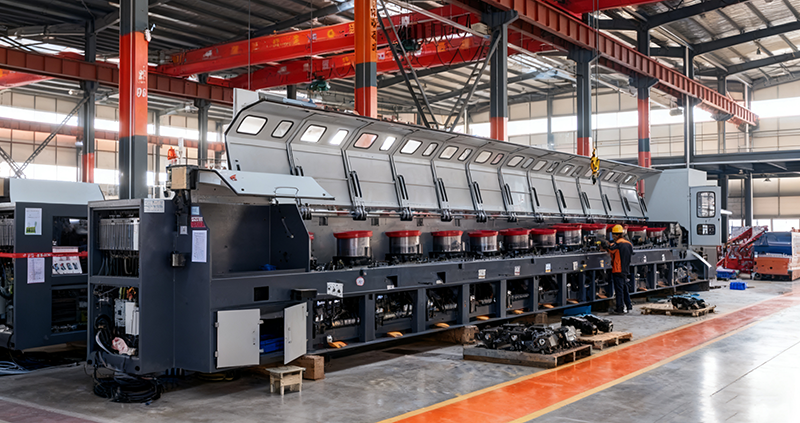
In numerous industrial fields such as hardware manufacturing, wire and cable production, and aerospace engineering, the precision processing of metal wires is a crucial link in product manufacturing. From commonly used iron nails and iron wires in daily life, to ultra-fine copper wires in high-end electronic devices, and high-strength steel wire ropes for construction machinery, the forming process of these metal wires with different specifications and performances is inseparable from the core equipment - the wire drawing machine. Through the scientific application of mechanics and structural design, the wire drawing machine transforms thick metal wires into finished wires with smaller diameters, higher precision, and better performance. Its working principle integrates core technologies from multiple disciplines including metal plastic deformation, mechanical transmission, and precision control, making it an indispensable key equipment in modern industrial production.
1. Core Principle: Scientific Application of Plastic Deformation
The essence of the wire drawing machine's operation lies in utilizing the unique plastic deformation characteristics of metal materials to achieve "diameter reduction and toughness enhancement" of wires through external tensile force. When a metal material is subjected to an axial tensile force exceeding its yield strength, it undergoes permanent deformation without breaking. During this deformation process, the grain structure inside the metal is elongated and refined, which not only reduces the cross-sectional area and extends the length of the wire, but also significantly improves its mechanical properties such as strength and hardness, while optimizing the surface finish.
This process follows the law of volume conservation, meaning the product of the cross-sectional area and length of the thick wire is equal to that of the finished wire. For example, when drawing a thick iron wire with a diameter of 6mm into a thin iron wire with a diameter of 3mm, its length will be extended to 4 times the original length (the cross-sectional area is proportional to the square of the diameter). To avoid wire breakage caused by local stress concentration, the wire drawing machine uses the "working cone angle" design of a dedicated die to enable the wire to undergo gradual transition deformation from thick to thin, ensuring uniform stress distribution and stable forming process.
2. Key Structures: Core Components for Collaborative Work
A high-performance wire drawing machine is a systematic project with multiple functional components working together. Different types of wire drawing machines (such as continuous, vertical, and horizontal models) have slight differences in structure, but the functional logic of their core components is consistent. The following takes the most widely used continuous wire drawing machine as an example to analyze its key components:
2.1 Pay-off Device: The "Source Guarantee" for Stable Output
The pay-off device is the starting link of the wire drawing machine, mainly composed of a spool pay-off stand and a tension regulator. Its core function is to fix the spool wound with thick metal wires, and control the wire release speed and tension through the tension regulator. This prevents winding, knotting, or tension fluctuations of the wire during the pay-off process, providing a stable raw material supply for the subsequent drawing process. The tension setting of the pay-off device varies according to the material of the wire: for hard wires (such as steel wires), the tension needs to be slightly higher to avoid loose pay-off; for soft wires (such as copper wires), the tension should be moderate to prevent wire breakage.
2.2 Wire Drawing Die: The "Core Gateway" for Wire Forming
The wire drawing die is a key component that determines the diameter, precision, and surface quality of the finished wire, and is known as the "heart" of the wire drawing machine. Its internal structure is usually divided into three parts: the entry cone, the working band, and the exit cone. The entry cone guides the wire to enter the die smoothly; the working band is the core area where the wire undergoes plastic deformation, and its hole diameter directly determines the diameter of the finished wire; the exit cone is used to reduce friction between the wire and the die, avoiding scratches on the wire surface.
According to the material and precision requirements of the processed wire, the material of the die also varies: when processing hard wires such as iron wires and steel wires, cemented carbide dies are mostly used due to their high wear resistance and long service life; when processing soft wires such as copper wires and aluminum wires or high-precision wires, diamond dies are often used because of their high surface finish, which can ensure the precision forming of the wire. In addition, the working cone angle of the die needs to be adjusted according to the wire characteristics, usually between 12° and 18°, to balance the deformation efficiency and wire quality.
2.3 Traction Device: The "Core Engine" for Power Output
The traction device is used to provide continuous and stable power for wire drawing, mainly consisting of traction wheels and a transmission mechanism. By adjusting the rotation speed of the traction wheels to be higher than that of the pay-off wheels, an axial tensile force is applied to the wire, prompting the wire to undergo plastic deformation under the constraint of the die. The rotational stability of the traction device directly affects the drawing quality of the wire. If the rotation speed fluctuates significantly, it will cause uneven wire tension, resulting in diameter deviation or breakage. Therefore, the traction devices of modern wire drawing machines mostly adopt frequency conversion speed regulation technology to achieve precise control of the rotation speed.
2.4 Cooling and Lubrication System: The "Key Auxiliary" for Stable Operation
During the wire drawing process, the deformation work inside the metal is converted into internal energy, causing the wire temperature to rise. At the same time, friction between the wire and the die intensifies die wear, affecting the wire surface quality. The cooling and lubrication system sprays special wire drawing oil (or emulsion) onto the die and wire continuously to achieve three functions: first, cooling and temperature reduction to prevent the wire from softening due to overheating and ensure its mechanical properties; second, lubrication and friction reduction to reduce friction between the wire and the die and extend the die service life; third, cleaning and rust prevention to remove metal chips generated during the drawing process and prevent the wire from rusting.
Different industries have different requirements for wire drawing oil: in the hardware industry, when processing iron wires and steel wires, high-viscosity and wear-resistant wire drawing oil should be selected; in the wire and cable industry, when processing copper wires and aluminum wires, low-viscosity and high-cleanliness wire drawing oil is required to avoid oil contamination affecting the subsequent insulation layer wrapping.
2.5 Precision Detection and Control System: The "Intelligent Defense Line" for Quality Assurance
To ensure the precision of the finished wire, modern wire drawing machines are generally equipped with online detection and control systems. Among them, the diameter detection device (such as a laser diameter gauge) can monitor the wire diameter in real time. When the detection result exceeds the allowable deviation range (usually ±0.02mm), the system will automatically alarm and shut down, facilitating the operator to adjust the die or process parameters in a timely manner; the tension control system uses sensors to sense the tension changes during the pay-off, drawing, and take-up processes in real time, and automatically adjusts the rotation speed of relevant components to prevent the wire from being too loose (resulting in messy winding) or too tight (resulting in breakage). In addition, some high-end wire drawing machines are also equipped with computer control systems, which can realize the storage, calling, and automatic adjustment of process parameters, improving production efficiency and product consistency.
2.6 Take-up Device: The "Final Link" for Finished Product Storage
The take-up device is used to wind the formed finished wire neatly on a spool for storage, transportation, and subsequent processing. The rotation speed of the take-up device needs to be synchronized with that of the traction device to ensure uniform wire tension and neat winding. According to the specifications and uses of the wire, the take-up device can be divided into spool take-up, disc take-up, and other forms. Some devices are also equipped with a wire arranging mechanism to further improve the regularity of wire winding.
3. Working Process: The Precision Transformation from Thick Wire to Thin Wire
Taking the iron wire drawing commonly used in the hardware industry as an example, the complete working process of the wire drawing machine can be divided into the following six steps, which clearly show the wire forming process:
3.1 Raw Material Preparation and Pay-off
Install the spool wound with thick iron wire (e.g., diameter 6mm) on the pay-off stand, check the surface quality of the wire to ensure there are no obvious scratches, rust, or other defects. Then, pass one end of the wire through the tension regulator, adjust the tension to an appropriate range, and start the pay-off device to ensure stable wire release without winding or knotting.
3.2 Wire Threading and Positioning in the Die
With the assistance of the traction device, pull one end of the iron wire to the wire drawing die, and pass it through the entry cone, working band, and exit cone of the die in sequence. Ensure the wire is aligned with the central axis of the die to avoid diameter deviation or surface scratches caused by eccentricity. At this time, the hole diameter of the die's working band has been set in advance according to the finished product requirements (e.g., diameter 3mm).
3.3 Continuous Drawing and Forming
Start the traction device, and the traction wheels rotate at the set speed. A stable axial tensile force is applied to the wire through the speed difference. Under the action of the tensile force, after the iron wire enters the working band of the die, its cross-section begins to shrink uniformly from 6mm to 3mm, and the length is extended synchronously. The grain structure inside the metal is refined, and the strength and hardness are improved. During this process, the constraint of the die ensures the roundness and diameter precision of the wire.
3.4 Cooling and Lubrication Treatment
During the drawing process, the cooling and lubrication system sprays wire drawing oil onto the die and wire continuously. The wire drawing oil not only quickly dissipates the heat generated by the wire and die to reduce the wire temperature, but also forms an oil film between the wire and the die to reduce friction and wear, and at the same time cleans the metal chips on the wire surface to ensure the wire surface finish.
3.5 Online Precision Detection
The diameter detection device monitors the diameter of the drawn wire in real time and compares the detection data with the set standard value. If the wire diameter deviation is within the allowable range, the equipment continues to operate; if the deviation exceeds the standard (e.g., greater than 3.02mm or less than 2.98mm), the system immediately sends an alarm signal and shuts down automatically. The operator needs to check whether the die is worn, whether the tension is stable, etc., and restart the equipment after the problem is solved.
3.6 Finished Wire Take-up and Storage
The qualified finished iron wire after detection is wound on the spool by the take-up device. During the take-up process, the wire arranging mechanism guides the wire to be distributed uniformly to avoid overlapping and disorder, ensuring neat wire winding and uniform tension. When the spool is fully wound, the equipment shuts down automatically, and a new spool is replaced to continue production. The wound finished wire can be directly used for subsequent processing such as cutting, electroplating, and bending.
4. Multi-pass Drawing: The Forming Solution for Ultra-fine Wires
When it is necessary to draw thick wires into extremely fine finished wires (such as copper wires or steel wires with a diameter of less than 0.5mm), a single drawing process will result in excessive deformation, which easily causes wire breakage and makes it difficult to ensure precision. In this case, the multi-pass continuous drawing process is required, that is, the wire passes through multiple dies with gradually decreasing hole diameters in sequence, and each pass completes a certain proportion of deformation (usually 10%-15% shrinkage per pass) to gradually reach the target diameter.
For example, to draw a copper wire with a diameter of 5mm into an ultra-fine copper wire with a diameter of 0.3mm, 10-12 drawing passes need to be set. The hole diameter of the first die is about 4.5mm, the second is about 4.0mm, and so on, with the last die having a hole diameter of 0.3mm. During the multi-pass drawing process, a cooling and lubrication system and a tension adjustment device need to be equipped after each pass to ensure uniform deformation and stable tension in each pass, and avoid fatigue fracture of the wire during the drawing process. In addition, the rotation speeds of the traction wheels of the multi-pass drawing machine need to be strictly matched to ensure the continuous and stable drawing speed of the wire and guarantee the precision and surface quality of the finished wire.
5. Industrial Applications and Technological Development Trends
5.1 Main Application Fields
The wire drawing machine has a wide range of applications in various industrial fields. Different industries have different requirements for wire specifications and performances, and the processes and structures of wire drawing machines will also be adapted accordingly:
Hardware Industry: Used for processing wires for products such as iron nails, iron wires, steel wire meshes, and fasteners. It requires high wire strength and smooth surface. Cemented carbide dies are mostly used, and the cooling and lubrication system needs to have strong wear resistance.
Wire and Cable Industry: Used for processing conductor wires such as copper wires and aluminum wires. It requires good electrical conductivity and high diameter precision of the wires. Diamond dies and low-viscosity wire drawing oil are mostly used to avoid affecting electrical conductivity.
Aerospace Industry: Used for processing high-strength and high-precision special steel wires and titanium wires. It requires stable mechanical properties and strong corrosion resistance of the wires. The wire drawing machine needs to have higher precision control and environmental adaptability.
Medical Device Industry: Used for processing ultra-fine stainless steel wires and titanium alloy wires for manufacturing surgical instruments and implants. It has extremely high requirements for wire diameter precision, surface finish, and biocompatibility. High-precision diamond dies and clean cooling and lubrication systems are required.
5.2 Technological Development Trends
With the continuous improvement of industrial production requirements for wire precision, efficiency, and environmental protection, the technology of wire drawing machines is constantly upgrading, mainly showing the following development trends:
Intelligent Upgrading: Integrate technologies such as the Internet of Things, big data, and artificial intelligence to realize automatic optimization of process parameters, real-time monitoring of equipment status, and fault early warning, improving production efficiency and product consistency.
High-precision Control: Adopt more advanced detection equipment such as laser diameter gauges and tension sensors, combined with servo control systems, to control the wire diameter precision within ±0.001mm, meeting the needs of high-end industries.
Energy Conservation and Environmental Protection: Develop low-energy-consumption transmission mechanisms and cooling and lubrication systems, and use recyclable and environmentally friendly wire drawing oil to reduce energy consumption and environmental pollution.
Modular Design: Design the core components of the wire drawing machine into a modular structure, facilitating equipment maintenance, upgrading, and customized production to adapt to the personalized needs of different industries.
Multi-material Adaptation: Develop wire drawing processes and equipment suitable for special metal materials (such as titanium alloys, high-temperature alloys, and composite materials) to expand the application range of wire drawing machines.
Conclusion
The working principle of the wire drawing machine seems simple, but in fact, it integrates core technologies from multiple disciplines such as metal materials science, mechanical engineering, and automatic control. Through the collaborative effect of "die constraint + external tensile force + cooling and lubrication + precision control", it realizes the transformation of metal wires from thick to thin, from low precision to high precision, and from ordinary performance to high performance. As a key equipment in industrial production, the technical level of the wire drawing machine directly affects the quality and competitiveness of downstream products. With the development of intelligent, high-precision, energy-saving, and environmental protection technology trends, the wire drawing machine will continue to iterate and upgrade, providing better and more efficient wire processing solutions for more industries and promoting the continuous progress of modern industry.

 Send Email
 Whatsapp