
Iron Nails vs. Stainless Steel Nails: A Comprehensive Comparison from Material to Application, Scenario-based Nail Selection
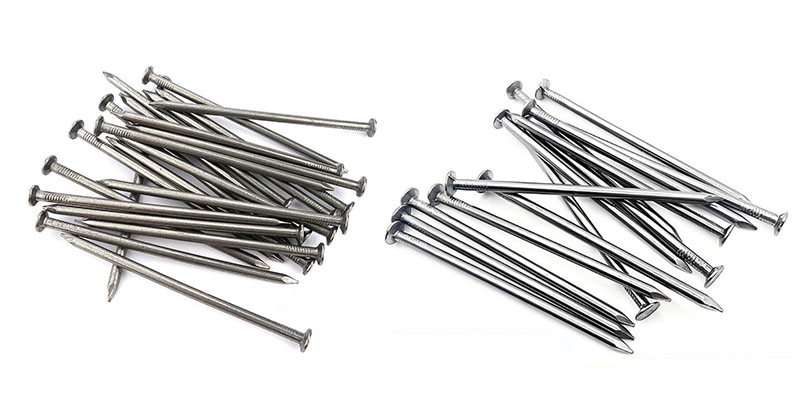
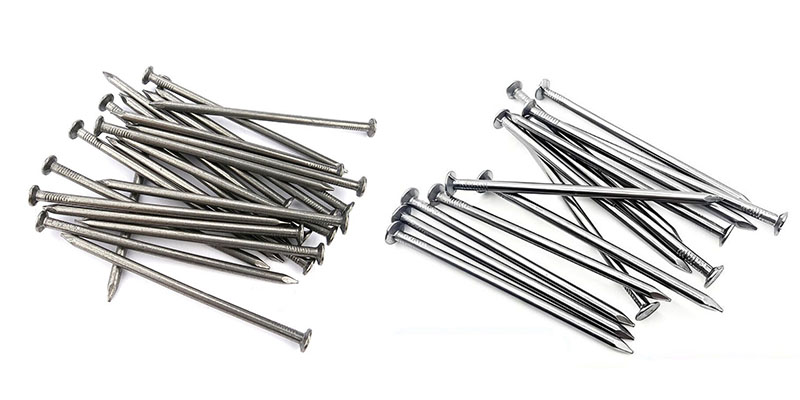
Comparison Dimension | Iron Nails | Stainless Steel Nails |
Material Composition | Low-carbon/middle-carbon steel, no rust-resistant alloy components | Contains chromium (≥10.5%) and nickel (8%-10% in 304, 10%-14% in 316); 316 additionally contains molybdenum |
Corrosion Resistance | Poor: Rusted in humid/outdoor environments within 1-3 months; rust easily stains wood and walls | Excellent: 304 resists general humidity; 316 resists salt spray and acids/alkalis (preferred for coastal/chemical industrial areas) |
Strength & Service Life | Medium hardness (HB100-150); prone to deformation under long-term stress; outdoor service life of 1-2 years | Higher hardness (HB150-200); resistant to tension and shear; 304 has a service life of 5-10 years, while 316 reaches 10-15 years |
Cost | Low: Approximately 1/3 to 1/2 the cost of 304 stainless steel nails | High: 316 is 20%-40% more expensive than 304 |
II. Scenario-Based Applications: Choose the Right Nail for Your Needs
Based on the usage environment, purpose, and strength requirements, accurately match the two types of nails to applicable scenarios:
1. Daily Indoor Scenarios: Distinguish Between "Temporary/Non-Load-Bearing" and "Long-Term/Load-Bearing"
Temporary Fixation/Non-Load-Bearing: Choose iron nails
Examples include hanging decorative paintings, installing curtain rods, and fixing furniture back panels/drawer bottoms. These scenarios have low durability requirements—iron nails are cost-effective, sufficient for use, and not a waste if replacement is needed later.
Long-Term Use/Load-Bearing: Choose 304 stainless steel nails
Scenarios like ceiling keels, wardrobe shelves, and indoor hardware fixation require long-term stress resistance and rust prevention. 304 stainless steel nails prevent deformation and ensure safety, making them especially suitable for humid bathroom areas.
2. Outdoor & Special Scenarios: Corrosion Resistance Is Key
General Outdoor (No Salt Spray): Choose 304 stainless steel nails
Garden fences, balcony clothes racks, and outdoor wooden chairs need to withstand wind and rain. 304 stainless steel nails prevent rusting in the short term, extend service life, and reduce maintenance hassle.
High-Corrosion Environments (Coastal/Chemical Areas): Choose 316 stainless steel nails
For coastal terrace floors, swimming pool handrails, and facilities near chemical plants, salt or acid-alkali substances in the air easily corrode metals. 316 stainless steel nails contain molybdenum, offering stronger corrosion resistance and no rust during long-term use.
Temporary Outdoor Projects: Choose iron nails
Construction enclosures, temporarily built sheds, and similar structures are disassembled after use, so high corrosion resistance is unnecessary. Iron nails significantly reduce costs and are suitable for short-term use.
3. Professional Field Scenarios: Match Performance Requirements
Furniture Manufacturing: Use iron nails for non-load-bearing parts; use 304 stainless steel nails for exposed parts of high-end furniture
Iron nails save costs for fixing ordinary furniture back panels and packaging. Exposed connectors of high-end solid wood furniture require both aesthetics and durability— the silvery luster of 304 stainless steel nails enhances overall texture.
Construction Engineering: Use iron nails for non-load-bearing temporary structures; use 304/316 stainless steel nails for load-bearing structures/outdoor projects
Iron nails are suitable for temporary construction guardrails. Load-bearing or long-term exposed scenarios (e.g., exterior wall fixation, outdoor landscape projects) require 304 (for general outdoor use) or 316 (for high-corrosion environments) to ensure structural safety.
III. Pitfalls to Avoid: 3 Common Misconceptions
Misconception: Iron nails can be used outdoors by painting them
Paint coatings easily peel off due to sun exposure and rain. The internal steel will still rust, and the rust will spread from the inside, causing loose fixation and increasing subsequent maintenance costs.
Misconception: 304 and 316 stainless steel nails are interchangeable
304 is only suitable for general humid environments. 316 must be used in coastal or chemical areas—otherwise, 304 will rust due to chloride ion or acid-alkali corrosion, failing to meet long-term use requirements.
Misconception: The thicker the nail, the better
Nail size should be selected based on the thickness of the fixed material. Thick nails easily crack thin wood panels, while thin nails cannot fix thick steel firmly. Choose the appropriate nail thickness according to material hardness and stress requirements.
Summary
The selection of iron nails or stainless steel nails mainly depends on the balance between "scenario needs and cost":
For short-term use, non-load-bearing purposes, and dry environments → Choose iron nails (low cost);
For long-term use, load-bearing purposes, and humid/outdoor/high-corrosion environments → Choose stainless steel nails (304 for general corrosion resistance, 316 for high corrosion resistance).
By matching nails to scenarios based on clear needs, you can not only meet usage requirements but also avoid unnecessary cost waste.

 Send Email
 Whatsapp